top of page

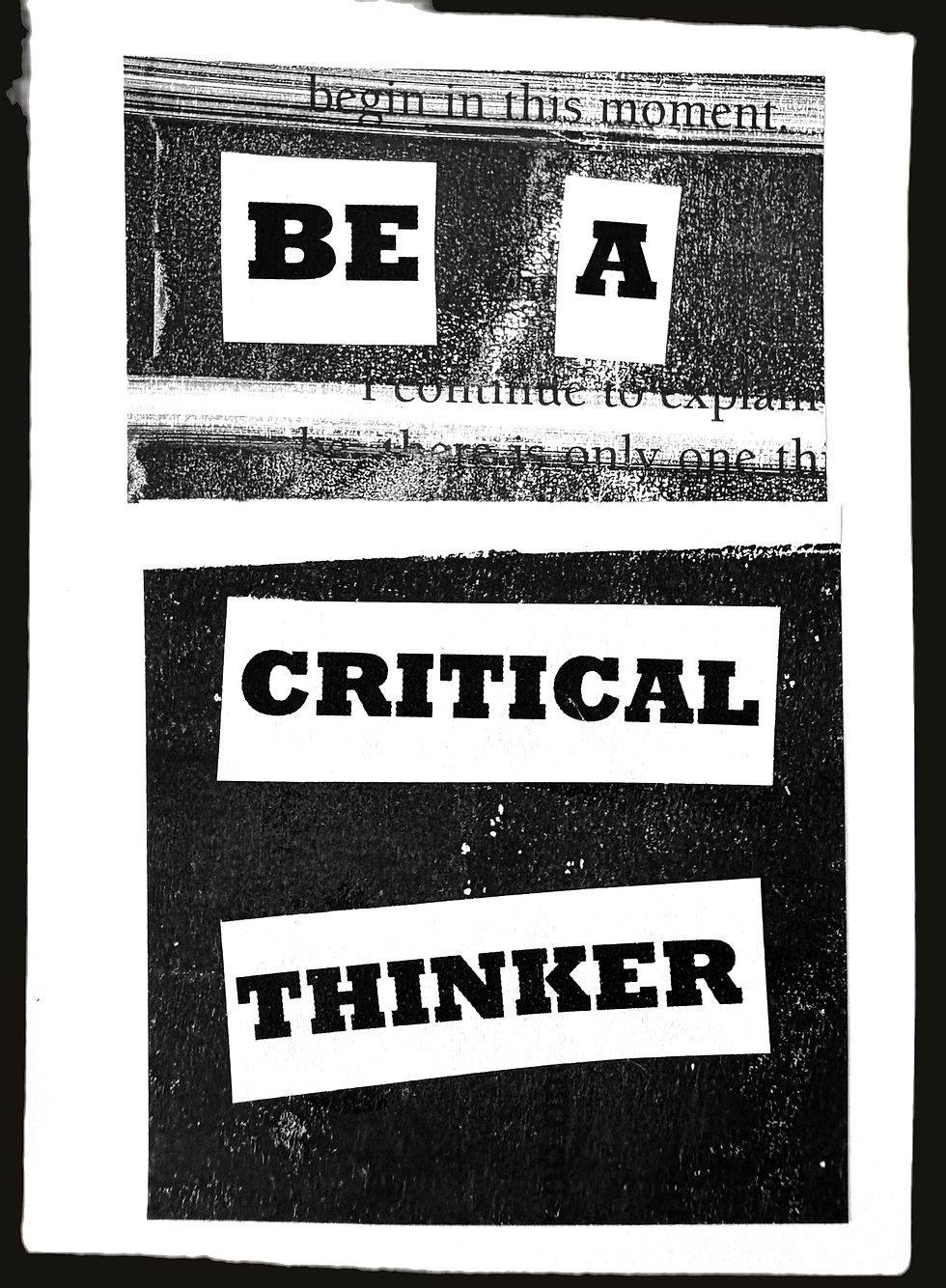
CRITICAL
THINKING
is
COOL

Updated: Jul 20


Critical thinking is a complex concept. It applies within and across disciplines, and can be defined in multiple ways from multiple perspectives. Let's cultivate complexity by considering multiple definitions. Here are (5) definitions to consider with links to credible and trustworthy sources you can find on our "STUFF" page. Because this is our website, not my website.


Critical Thinking


Definition #1. "...critical thinking requires discernment. It is a way of approaching ideas that aims to understand core, underlying truths, not simply that superficial truth that may be most obviously visible." (Teaching Critical Thinking: Practical Wisdom, p. 9)


Critical Literacy


Definition #2. "[Critical literacy] signals a move to question the naturalized assumptions of the discipline, its truths, its discourses and its attendant practices." (Literacy and Power, p. 13)


Definition #3. "...critical literacy means making one's self present as part of a moral and political project that links the production of meaning to the possibility for human agency, democratic community, and transformative social action." (Literacy: Reading the Word and the World, p. 15)


The Art of Rhetoric


Definition #4. Rhetoric is "the systematic study and intentional practice of effective symbolic expression. Effective here [] mean[s] achieving the purpose of the symbol-user, whether that purpose is persuasion, clarity, beauty, or mutual understanding." (The History and Theory of Rhetoric: An Introduction, Eighth Edition, p. 10)


Definition #5. Rhetoric is "the art, theory, and practice of ethical communication. (Everyone's an Author, p. 6)


It is important to recognize that rhetoric can be used for both ethical and unethical purposes. This speaks to the importance of critical reading, writing, and thinking–whether reading a news article, billboard, political yard sign, or the marketing elements on a website and items intended to be sold in exchange for your hard earned dollars. Likewise, studying the intentional rhetorical choices made by others empowers you to make intentional (and ethical) rhetorical choices when designing or composing any kind of planned communication–whether a poster, zine, speech, blog, or social media post.


Critical thinking takes time. Let's make time. Critical thinking is not just for English classes. Regardless of the information you are teaching or learning, disseminating or consuming, composing or sharing, critical thinking is relevant and can be applied–should be applied–whether teaching biology, making a purchase, watching a documentary, or interacting on social media with influencers–remember, they are called influencers for a reason.


Updated: 15 hours ago

black and red collage with text listing the five elements of the rhetorical situation: rhetor, audience, exigence, purpose, constraints
5 elements of the rhetorical situation


What are the (5) elements of the rhetorical situation?


Employing the art of rhetoric provides an opportunity to build more informed understanding by considering a text (cultural artifact) in its rhetorical situation. It is one way to systematically study effective symbolic expression (Herrick, p. 10). Doing so provides an opportunity to identify and considering rhetorical choices made by others in the co-construction meaning. Additionally, it is a process of facilitating emergent articulation of what we think we know or believe to be true–whether in speaking, writing, or other forms of symbolic expression. Examples of symbolic communication include words (spoken and written), gestures (body language, sign language, dance), sounds (music, sound effects, silence), and images (art, photography, digital images, still and moving pictures). We communicate, or transmit messages, using a variety of symbolic means.


The Rhetorical Situation


The rhetorical situation refers to the context in which a rhetorical act takes place. A rhetorical act involves persuasive communication that influences how an audience feels, thinks, and acts. A rhetorical act minimally consists of a rhetor, issue, and audience. The context in which it occurs can be broad (historical, cultural, social, political) or narrow (specific circumstances that pertain to a particular issue).


Rhetor. The rhetor refers to any person or group of people that composes discourse intended to affect an audience's or broader community's feeling, thoughts, and actions.


Audience. The audience refers to any people designated by the rhetor as readers or hearers of his/her/their composed text. The audience can be real or imagined, contemporary or historical, as well as primary or secondary, and intended or unintended.


Exigence. An exigence is any event or an occurrence that prompts rhetorical discourse by joining a conversation that keeps the information cycle moving. In other words, it begins the cycle of rhetorical discourse about a particular issue. For example, Hurricane Katrina prompted rhetorical discourse about class and race in the United States. Likewise, any school shooting reignites rhetorical discourse about gun violence and gun rights.


Purpose. When systematically studying or intentionally practicing rhetorical moves, it is important to identify any intended outcomes of the rhetorical discourse identified–implicitly or explicitly–by the rhetor.


Constraints. These are the chosen or required limitations in which a rhetor must work. Constraints might be related to genre, medium, language register (formal, academic, creative, social), time, or word count, among many other things. For example, advertising teams must create commercials for a thirty second spot. Artists might challenge themselves to create daily self-portraits using only black and white media for one hundred consecutive days.


Prompt


Find a text (cultural artifact) to analyze and consider in its rhetorical situation. All texts exist within a con(text). A text could be a song, book cover, TikTok, film, painting, photograph, billboard, bumper sticker, tattoo, etc. Engage your curiosity. Ask questions.


  • Who is the rhetor? Do some initial research. What can you find out about them? Are your sources credible and trustworthy?

  • Who is the intended audience? Are you part of that audience?

  • What is the exigence? What is the rhetor responding to (movie premiere, political election, natural disaster, fashion show, album release, cartoon, etc)? When and where did it happen? What is the context?

  • What is the intended purpose? What is the rhetor attempting to do to affect the audience? (entertain, advocate, highlight, sensationalize, dismiss, diminish, argue, promote, advertise, condemn, motivate, energize, balance, consider, etc).

  • What are the constraints? What are the limitations within which the rhetor had to work to compose this piece of rhetorical discourse? Was their a time limit? Word count? Space limitations? How did these constraints inform and influence the choices made by the rhetor when composing the rhetorical discourse?

Updated: Jul 14

pink and red graphic art collage with the words they are called influencers for a reason
Influencers want to influence your thinking and behavior. Think critically. Then decide.


CRITICAL
THINKING
is
COOL

Drop me a line. Or three.

© 2026 by Susie Santee. Critical Thinking Unleashed. All rights reserved.

bottom of page